
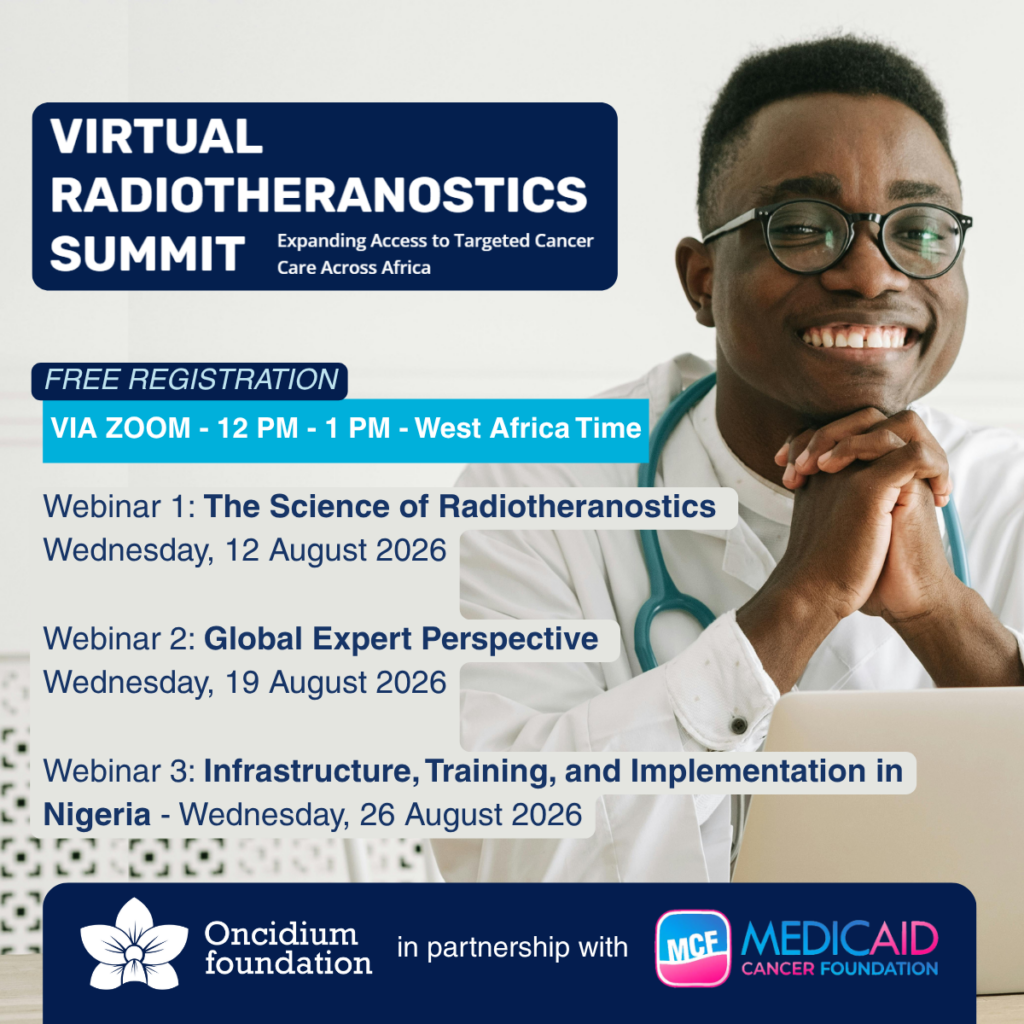
Via Zoom, from 12 PM to 1 PM (West Africa Time)
- The Science of Radiotheranostics – Wednesday, 12 August 2026
- Global Expert Perspective – Wednesday, 19 August 2026
- Infrastructure, Training, and Implementation in Nigeria – Wednesday, 26 August 2026
Radiotheranostics is advancing rapidly, offering new hope for cancer patients by combining molecular imaging with targeted radiation to precisely detect and treat tumors. By using a single molecule to both visualize and treat cancer, it eliminates the trial-and-error approach of traditional oncology and spares healthy tissue from unnecessary damage.
For nations, investing in this field isn’t just about advancing science—it means strengthening a key pillar of modern, personalized medicine and improving patient survival. The Virtual Radiotheranostics Summit is organized by the Oncidium foundation in collaboration with Medicaid Cancer Foundation. Across three one-hour sessions, participants will attend webinars covering the science of radiotheranostics, the practical pathway to implementation in Nigeria, and lessons from global experts.
Whether you are a radiation oncologist, medical physicist, radiation therapists/radiographers, oncology nurse, dosimetrist, a hospital leader, a policymaker, or other related professionals, this summit is your entry point into one of the most promising frontiers in cancer care, and a call to action for equitable access.
AGENDA
Wednesday, 12 August 2026 | Webinar 1: The Science of Radiotheranostics
Speakers & Moderator:
Akintunde Orunmuyi - Nuclear Medicine Department, University Hospital Southampton NHS Foundation Trust. The Oncidium foundation ambassador.
‘Mayowa Kolade -Nuclear Medicine Consultant, Molecular Imaging & Theranostics Specialist
Iyobosa B. Uwadiae - Moderator -Educator | Medical Physicist | Grief Educator | President, Nigerian Association of Medical Physicists (NAMP)
Key Topics:
- Introduction to radiotheranostics and its role in precision medicine
- Mechanisms of targeting (ligands, receptors, radiotracers)
- Diagnostic–therapeutic pairing and treatment workflows
- Clinical applications (e.g., prostate cancer, neuroendocrine cancers)
- Safety, dosimetry, and patient selection
- Overview of the global landscape and emerging therapies
- Relevance to Nigeria’s cancer burden and care pathways
Wednesday, 19 August 2026 | Webinar 2: Global Expert Perspective
Speakers & Moderator:
Mahipal Rathod - Assistant Director, Nuclear Pharmacy - The Ohio State University
Iyobosa B. Uwadiae - Moderator -Educator | Medical Physicist | Grief Educator | President, Nigerian Association of Medical Physicists (NAMP)
Key Topics:
- Evolution of radiotheranostics globally
- Lessons from successful implementation in different healthcare systems
- Common challenges and how to overcome them
- Future directions in the field (emerging therapies, technologies)
- Opportunities for Nigeria and the broader African region
- Building sustainable, locally led programmes
Wednesday, 26 August 2026 | Webinar 3: Infrastructure, Training, and Implementation in Nigeria
Speakers & Moderator:
Prof. Abidemi Omonisi - President/CEO of the Nigerian Cancer Society
Prof. Musa Ali-Gombe, M.B.B.S, MNIM, M.P.A, FWACS, FMCR - Director General of the National Institute for Cancer Research and Treatment (NICRAT)
Akintunde Orunmuyi - Nuclear Medicine Department, University Hospital Southampton NHS Foundation Trust. The Oncidium foundation ambassador.
Iyobosa B. Uwadiae - Moderator -Educator | Medical Physicist | Grief Educator | President, Nigerian Association of Medical Physicists (NAMP)
Key Topics:
- Current state of nuclear medicine in Nigeria
- Infrastructure requirements:
- Imaging systems (PET/CT, SPECT)
- Radiopharmacy and isotope supply chains
- Radiation safety and waste management
- Workforce development:
- Training needs for physicians, physicists, pharmacists, and technologists
- Regulatory and policy considerations
- Barriers to access (cost, reimbursement, logistics, workforce gaps)
- Implementation strategies:
- Pilot centres and phased scale-up
- Public–private partnerships
- Regional centres of excellence
- International collaboration opportunities
- Measuring clinical and economic impact